
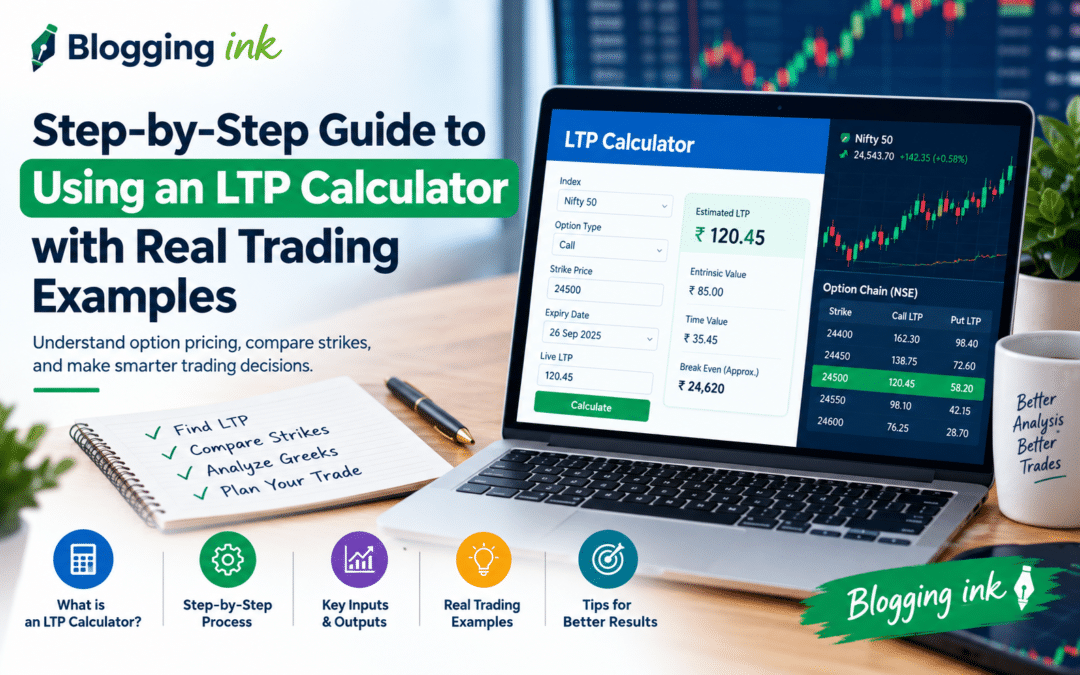
Step-by-Step Guide to Using an LTP Calculator with Real Trading Examples
In Part 3 we looked at the math behind an LTP Calculator, including what intrinsic value’s what time value is what implied volatility is, how price discovery works and what the Option Greeks do. Now it is time to use these ideas in situations. This part shows a step by step way to use an LTP Calculator with the NSE Option Chain helping you look at Nifty, Bank Nifty, Sensex options on commodities and weekly expiry contracts with more confidence.
Why a Step-by-Step Guide to Using an LTP Calculator is Important?
Many traders open the NSE Option Chain look at the Traded Price and then buy or sell an option. It is simple. This way often misses important things like how much trading is happening, what the Open Interest is, what the implied volatility is and how time affects the price.
A clear way of doing things helps cut down on choices and makes things more steady. If you follow the steps each time you can look at different contracts in the same way instead of just going with a feeling.
An LTP Calculator helps the most when you use it as part of this way of doing things.
A Professional Way to Do Things Before Every Options Trade
Professional traders usually do these steps before they make a trade:
- Pick the asset you want to trade.
- Look at the market trend using charts.
- Choose the time for the option to end.
- Open the NSE Option Chain.
- Look at Open Interest and changes in Open Interest.
- Compare Implied Volatility.
- Check the amount of trading. How much is happening.
- Use an LTP Calculator to look at prices across strike prices.
- Look at the chance of losing compared to the chance of making money.
- Make the trade with set stop-loss and target prices.
This way helps make sure nothing important is missed.
Step-by-Step Guide to Using an LTP Calculator with Real Trading Examples Step 1: Pick the Asset You Want to Trade
Start by deciding which asset you want to trade.
Examples are:
- Nifty 50
- Bank Nifty
- Sensex
- Fin Nifty
- Midcap indices (if they’re there)
- Contracts for commodities (like crude oil)
The asset you pick decides what strike prices are there what times the options. How much the options cost.
Step-by-Step Guide to Using an LTP Calculator with Real Trading Examples Step 2: Look at the Market Trend
Before you look at the option chain check what is happening in the market.
Ask yourself:
- Is the market going up down or staying the same?
- Is the market near a support or resistance point?
- Are there things happening today that could affect the market?
- Is the implied volatility high or very low?
This helps you choose the options that match what is happening.
Step-by-Step Guide to Using an LTP Calculator with Real Trading Examples Step 3: Choose the Right Time for the Option to End
Most option chains show times when the options end.
Common choices are:
- Weekly expiry
- Monthly expiry
Weekly Expiry
Good for:
- Trading during the day / Indtraday
- Quick moves / Scalping
- Short-term trades
What will you get:
- time value.
- Quick loss of value over time.
- More sensitive to changes.
Monthly Expiry
Good for:
- Trading over a few days / Swing Trade
- Longer plans / Positional Trade
- Trades that take time to work out
What will you get:
More time value.
- Slower loss of value over time.
- More options if the trade takes longer.
- Pick the time that fits your plan and how much risk you want to take.
Step-by-Step Guide to Using an LTP Calculator with Real Trading Examples Step 4: Look at the NSE Option Chain
Once you pick the time look at the option chain.
Check:
- What strike prices are there.
- What the Open Interest (OI) is.
- What has changed in Open Interest (OI).
- How much is being traded.
- What the implied volatility (IV) is.
- What the bid and ask prices are.
- What the last traded price’s (LTP).
Do not decide just based on the price of the option.
Step 5: Find the At-the-Money Strike
Lets say, Nifty is trading at 25,005
Available strikes:
- 24,900
- 24,950
- 25,000
- 25,050
- 25,100
The 25,000 strike is the closest to the price and is the At-the-Money option.
ATM options usually have:
- More trading happening / Heigh Liquidity
- Smaller gaps between what people offer and what they ask.
- More active Traders
Step 6: Compare Strikes with an LTP Calculator
An LTP Calculator helps compare different options more easily.
Example:
| Strike | Call LTP | Put LTP |
| 24,900 | ₹205 | ₹62 |
| 25,000 | ₹158 | ₹118 |
| 25,100 | ₹112 | ₹172 |
| 25,200 | ₹78 | ₹228 |
Do not just choose the one. Look at:
- How far it is from the price.
- How much is being traded.
- What the Open Interest is.
- What the implied volatility is.
- What you think the market will do.
Step 7: Look at Open Interest
Lets say the option chain shows:
| Strike | Call OI | Put OI |
| 24,900 | 4,20,000 | 9,80,000 |
| 25,000 | 7,50,000 | 8,20,000 |
| 25,100 | 12,80,000 | 5,10,000 |
What it might mean:
- The highest Call OI at 25,100 may show a place where the price might stop.
- The Put OI at 24,900 may show a place where the price might stop.
An LTP Calculator helps compare the prices around these points.
Step 8: Check Implied Volatility
Before you trade look at the implied volatility.
High IV
Benefits: More changes in the price.
Things to think about: Options are more expensive.
Low IV
Benefits: Options are cheaper.
Things to think about: The market is not expected to move
Implied volatility should always be checked along with the price of the option not alone.
Step 9: Look at the Risk and Reward
Lets say two call options are there:
| Strike | Premium | |
| 25,000 CE | ₹160 | |
| 25,100 CE | ₹110 |
Even though the 25,100 CE is cheaper it might need a move in the index to make money.
An LTP Calculator helps compare these choices clearly.
Step 10: Make the Trade
Before placing the trade decide:
- What price you want to start at / Entry price
- Where to stop losing money / Stop-loss
- Where to take profits.
- How much you are trading.
Do not start a trade without a plan for when to close it.
Step-by-Step Guide to Using an LTP Calculator with Real Trading
Examples
Example 1: Nifty
Current Nifty: 25,000
Market view: Somewhat up.
Option chain:
| Strike | CE LTP | CE OI |
| 24,900 CE | ₹210 | 4,80,000 |
| 25,000 CE | ₹155 | 8,50,000 |
| 25,100 CE | ₹108 | 11,90,000 |
What it means:
- The ATM option has trading.
- The highest call OI, at 25,100 may show a place where the price might stop.
- If Nifty goes over 25,100 with trading and more OI, higher strike options may be better.
The LTP Calculator helps compare prices and see how different strike prices may change if the market moves more.
Example 2: Bank Nifty
Current Bank Nifty: 57,200
Option chain:
| Strike | CE LTP | PE LTP |
| 57,000 CE | ₹365 | ₹120 |
| 57,200 CE | ₹255 | ₹235 |
| 57,500 CE | ₹145 | ₹355 |
Observations
- ATM strike shows premiums.
- ITM call has intrinsic value.
- OTM call is cheaper but more dependent on upside.
A free LTP Calculator BankNifty option chain can help compare these contracts and assess their sensitivity to market movement.
Example 3: Sensex
Current Sensex: 83,000
Option chain:
| Strike | CE LTP | PE LTP |
| 82,800 CE | ₹250 | ₹85 |
| 83,000 CE | ₹170 | ₹165 |
| 83,200 CE | ₹115 | ₹245 |
If the market is expected to remain range-bound traders should be cautious about paying premiums particularly if implied volatility is elevated.
A free LTP Calculator Sensex option chain can assist in comparing premiums across strikes and expiries.
Example 4: Commodity (Crude Oil)
Commodity options often exhibit volatility characteristics compared to equity indices.
Assume that Crude Oil is trading at ₹6,800
Option chain:
| Strike | Call LTP | Put LTP |
| 6,700 | ₹165 | ₹72 |
| 6,800 | ₹118 | ₹116 |
| 6,900 | ₹78 | ₹168 |
A Commodity LTP Calculator or Crude Oil LTP Calculator can help traders evaluate behavior during periods of heightened volatility or major geopolitical events.
Example 5: Weekly Expiry
Weekly expiry options behave differently because time decay accelerates rapidly.
Current Nifty: 25,000
One day before expiry:
Strike LTP
| Strike | LTP | |
| 25,000 CE | ₹48 | |
| 25,100 CE | ₹16 | |
| 25,200 CE | ₹4 |
A small move in the index can produce a significant percentage change in these premiums. However if the expected move does not occur Theta decay can quickly erode option value.
A weekly expiry AI LTP Calculator can help traders estimate how premium changes may be affected by time decay and implied volatility during the final days before expiry.
Common Mistakes When Using an LTP Calculator
experienced traders can misuse these tools. Common mistakes include:
- Buying the option without considering probability.
- Ignoring Open Interest and Change in OI.
- Overlooking implied volatility.
- Trading illiquid contracts with bid-ask spreads.
- Ignoring time decay near expiry.
- Entering trades without predefined risk parameters.
- Focusing on size instead of expected payoff.
Avoiding these pitfalls can significantly improve trading discipline.
Tips for Getting the Most from an LTP Calculator
To maximize the value of an LTP Calculator:
- Compare strike prices before making a decision.
- Analyze premiums alongside OI, Volume and IV.
- Monitor changes throughout the trading session than relying on a single snapshot.
- Pay attention to liquidity and execution costs.
- Use the calculator as an aid not as a prediction engine.
- Combine option chain analysis with charts and sound risk management.
Key Takeaways
- A structured workflow helps traders use an LTP Calculator effectively than relying on option premiums alone.
- Always begin with the broader market context then analyze the NSE Option Chain before selecting a contract.
- Compare strike prices, Open Interest, Implied Volatility, Volume and liquidity together to make informed decisions.
- Practical examples, across Nifty, Bank Nifty, Sensex and commodity options demonstrate how the same analytical framework can be applied to markets.
- Weekly expiry contracts require attention because accelerated time decay and volatility can significantly impact option premiums.
In Part 5, we’ll compare some of the best LTP Calculators available to traders, including solutions from Sensibull, Dhan, Angel One, and AI-powered platforms. We’ll also examine key features, strengths, limitations, and use cases to help you choose the tool that best fits your trading style, followed by a comprehensive comparison table.
Recent Comments