
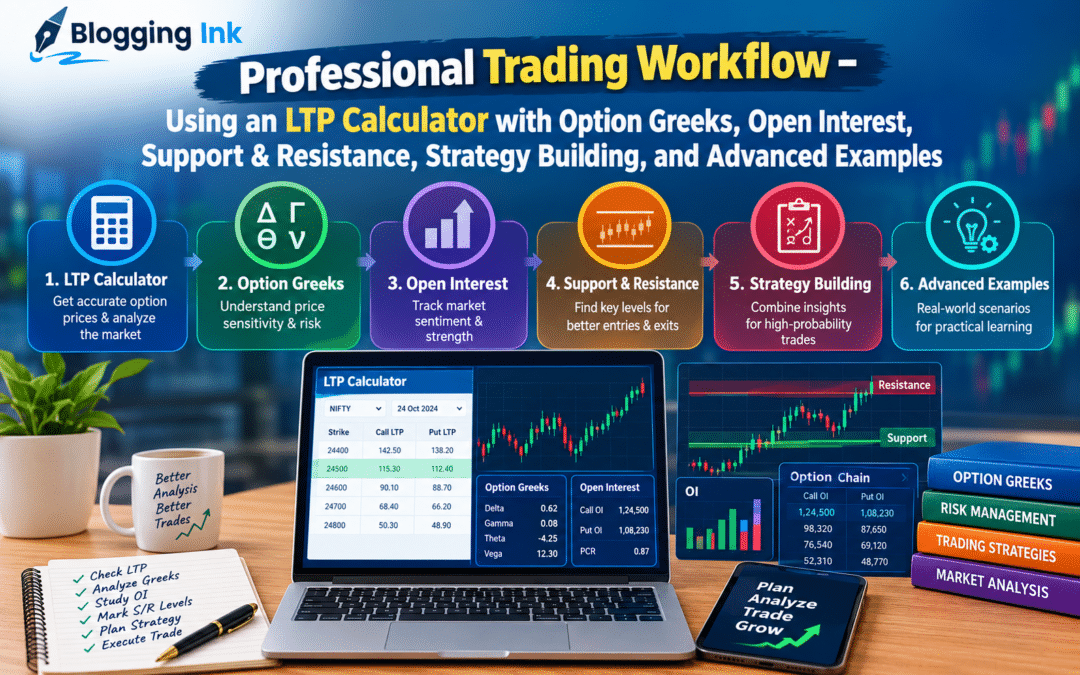
Professional Trading Workflow – Using an LTP Calculator with Option Greeks, Open Interest, Support & Resistance, Strategy Building, and Advanced Examples
Professional Trading Workflow
In Part 8 we looked at the common errors that options traders make such as picking the wrong strike price not paying attention to Open Interest not understanding implied volatility trading without a plan for managing risk and trading too much. Now we will bring everything together into a way of trading. You will see how expert traders use an LTP Calculator, NSE Option Chain, Option Greeks, Open Interest, technical analysis and disciplined trading to make decisions.
From Beginner to Professional: A Structured Trading Process
One of the differences between beginner traders and professional traders is consistency.
Beginners often ask:
- Which option should I buy?
- Will the market go up today?
- Which strike will double?
Professionals ask:
- What is the current market structure?
- Where are the main support and resistance levels?
- What does the option chain show?
- How is implied volatility acting?
- What are the Option Greeks showing?
- Does the trade fit my risk management plan?
A professional process turns trading from guessing into a way of making decisions.
The Complete Professional Trading Workflow
Below is a working process used by experienced options traders.
Professional Trading Workflow Step 1: Look at the Overall Market Trend
Before looking at the option chain figure out the picture of the market.
Check:
- Daily trend
- 4-hour trend
- 1-hour trend
- Market mood
- Big economic events
- How other markets are doing
Ask:
- Is the market going up or down?
- Is it staying the same?
- Is volatility going up?
- Are there any events happening today?
Trading with the trend can create better chances for success.
Professional Trading Workflow Step 2: Find Support and Resistance
Professional traders always look for key price levels before making a trade.
Support and resistance can be found using:
- High and low from the day
- High and low for the week
- Swing points
- Moving averages
- VWAP
- Fibonacci levels
- High Open Interest strikes
Example:
Nifty: Current Price:25,040
Support: 24,950
Resistance: 25,150
These levels help set the context before choosing an option contract.
Professional Trading Workflow Step 3: Check the NSE Option Chain
Now look at the option chain.
Review:
- Call prices
- Put prices
- Strike prices
- Open Interest
- Change in OI
- Volume
- Implied Volatility
- Bid-Ask spread
- Traded Price (LTP)
An LTP Calculator NSE option chain helps you compare strikes quickly instead of checking each one individually.
Professional Trading Workflow Step 4: Look at Open Interest
Open Interest often shows where a lot of people are active in the market.
Example:
| Strike | Call OI | Put OI |
| 24,900 | 3,80,000 | 10,20,000 |
| 25,000 | 6,60,000 | 8,90,000 |
| 25,100 | 12,40,000 | 4,80,000 |
Interpretation:
- High Put OI near 24,900 may signal support
- High Call OI near 25,100 may signal resistance
These are observations not promises. They should always be checked with how the price is moving.
Professional Trading Workflow Step 5: Study the Change in Open Interest
Open Interest is more helpful when combined with price movement.
| Price | OI | Possible Interpretation |
| Price ↑ | OI ↑ | Long Build-up |
| Price ↓ | OI ↑ | Short Build-up |
| Price ↑ | OI ↓ | Short Covering |
| Price ↓ | OI ↓ | Long Unwinding |
Knowing these patterns helps traders understand what is happening in the market not just how the price is moving.
Step 6: Look at Implied Volatility
Before choosing an option check the IV.
High IV
- Higher prices
- Expected movement
- Sensitive to changes
Low IV
- Lower prices
- Expected movement
- Sensitive to changes
An LTP Calculator should always be used with IV, not alone.
Step 7: Check the Option Greeks
Expert traders pay attention to the Option Greeks.
Delta: Tells how much the price may change with a move in the underlying. Higher Delta means response to price changes.
Gamma: Shows how fast Delta changes. Gamma is very important as the contract approaches expiry.
Theta: Represents time decay. Option buyers watch Theta closely because prices drop faster as expiry nears.
Vega: Measures how sensitive the price is to changes in IV. Higher Vega means the price is more affected by IV.
Rho: Shows how sensitive the price is to interest rate changes. It is not as important for short-term index options. Can matter for longer contracts.
Step 8: Compare Several Strike Prices
Never look at one contract.
Example: Current Nifty: 25,000
| Strike | Premium | Delta |
| 24,900 CE | ₹205 | 0.72 |
| 25,000 CE | ₹155 | 0.53 |
| 25,100 CE | ₹108 | 0.36 |
of picking the cheapest compare:
- Delta
- OI
- IV
- Liquidity
- Risk
- Expected market movement
An LTP Calculator option chain makes these comparisons easier.
Step 9: Choose the Right Strategy
Professional traders pick strategies based on the market not on feelings.
Bullish Market
Possible choices:
- Long Call
- Bull Call Spread
- Cash-Secured Put (if suitable)
Bearish Market
Possible choices:
- Long Put
- Bear Put Spread
- Bear Call Spread (better to use defined-risk)
Flat / Sideways Market
Possible strategies include:
- Iron Condor
- Iron Butterfly
- Covered Call (for portfolios)
Volatility: Some traders use defined-risk selling strategies but always check Vega and limits.
Low Volatility: Debit strategies or long-volatility strategies may be considered if the analysis supports it.
Strategy selection must always match the traders goals, experience and ability to handle risk.
Step 10: Define Risk Before Reward
Every Professional traders ask: “How much can I lose?” before asking: “How much can I make?”
Every trade must have:
- Entry
- Stop-loss
- Target
- Position size
- Maximum acceptable loss
Protecting capital is the important goal.
Step 11: Execute with Discipline
Execution must follow the trading plan.
Avoid:
- Moving stop-losses without a reason
- Averaging losing positions without a strategy
- Deciding based on emotions
- Trading to get back at the market.
Being consistent leads to results over time than making changes on the fly.
Advanced Example 1: Bullish Nifty Trade
Current Nifty: 25,020
Support: 24,950
Resistance: 25,150
Option Chain:
| Strike | CE Premium | OI |
| 25,000 | ₹160 | 8,20,000 |
| 25,100 | ₹112 | 11,60,000 |
Observations:
- Market is above support
- High liquidity at the at-the-money strike
- Resistance is clear near 25,100 from call interest
Possible steps we can take:
- Check the trend
- Watch for a breakout
- Use the LTP Calculator to compare premiums
- Check Delta and IV
- Trade only if the setup fits the plan
Advanced Example 2: Bank Nifty Intraday Trade
Current Bank Nifty: 57,220
Option Chain:
| Strike | CE | PE |
| 57,000 | ₹365 | ₹122 |
| 57,200 | ₹252 | ₹238 |
| 57,500 | ₹145 | ₹352 |
Professional Workflow:
• Look at the overall trend.
- Analyze where open interest is concentrated
- Compare strikes
- Check IV
- Review Greeks
- Take the trade only if the setup fits the rules
Advanced Example 3: Weekly Expiry
Current Nifty: 25,000
One day before expiry:
| Strike | Premium | |
| 25,000 CE | ₹50 | |
| 25,100 CE | ₹18 | |
| 25,200 CE | ₹5 |
Thoughts:
- Theta decay is speeding up
- Gamma is more sensitive
- IV can change fast
- Liquidity must be watched closely
Of looking for the cheapest premium experienced traders look at probability, liquidity and expected movement before trading.
Combining Technical Analysis with an LTP Calculator
An LTP Calculator works best when used with analysis.
Useful checks include:
- Trend direction
- Moving averages
- VWAP
- RSI
- MACD
- Price action
- Volume
- Support & Resistance
No one tool should be used as the way to make a decision.
Professional Daily Trading Checklist
Before starting a trade check:
- Overall market trend
- Economic calendar
- Support and Resistance
- Option Chain
- Open Interest
- Change in Open Interest
- Volume
- Implied Volatility
- Option Greeks
- LTP comparison
- Liquidity
- Bid-Ask spread
- Position size
- Stop-loss
- Risk-Reward ratio
If many parts are missing or not matching wait of forcing a trade.
Building Your Personal Trading System
of copying another trader create a process that you can follow.
Your trading journal should have:
- Date and time
- Asset
- Expiry
- Strike price
- Exit
- Reason for the trade
- Price at entry
- Open interest notes
- IV level
- Greeks
- Result
- What was learned
Reviewing regularly helps spot habits and mistakes.
Common Professional Habits
Experienced traders often:
- Focus on the process not the result
- Stick to the rules
- Limit emotional choices
- Accept that losses happen
- Keep learning and improving
- Prioritize capital protection over gains
These habits help in the run more than any single tool.
Internal Linking Opportunities
This section connects with:
- Option Greeks Explained
- Open Interest Analysis
- Support and Resistance Trading Guide
- VWAP Trading Strategy
- Risk Management in Options Trading
- Position Sizing Guide
- Trading Psychology
- Bull Call Spread Strategy
- Iron Condor Strategy
- Weekly Expiry Trading Guide
These links help build authority and make navigation easier.
Key Takeaways
- A professional options trading process includes market trend, support and resistance NSE Option Chain, Open Interest, IV, Greeks and an LTP Calculator.
- Looking at strikes checking liquidity and understanding premiums is better, than just picking low price contracts.
- Choosing a strategy must match the market and risk levels not emotions or recent price changes.
- Having a written plan sticking to it and keeping a journal help improve over time.
- The LTP Calculator is best when used as part of an analysis not as a single signal.
In the final chapter, we’ll complete this pillar guide with a Professional Trading Checklist, 20+ Pro Tips, a comprehensive summary, a strong call-to-action (CTA), 5 SEO-optimized FAQs, and schema-friendly formatting designed to improve visibility in Google Search, Featured Snippets, and AI-generated search experiences.
Recent Comments