
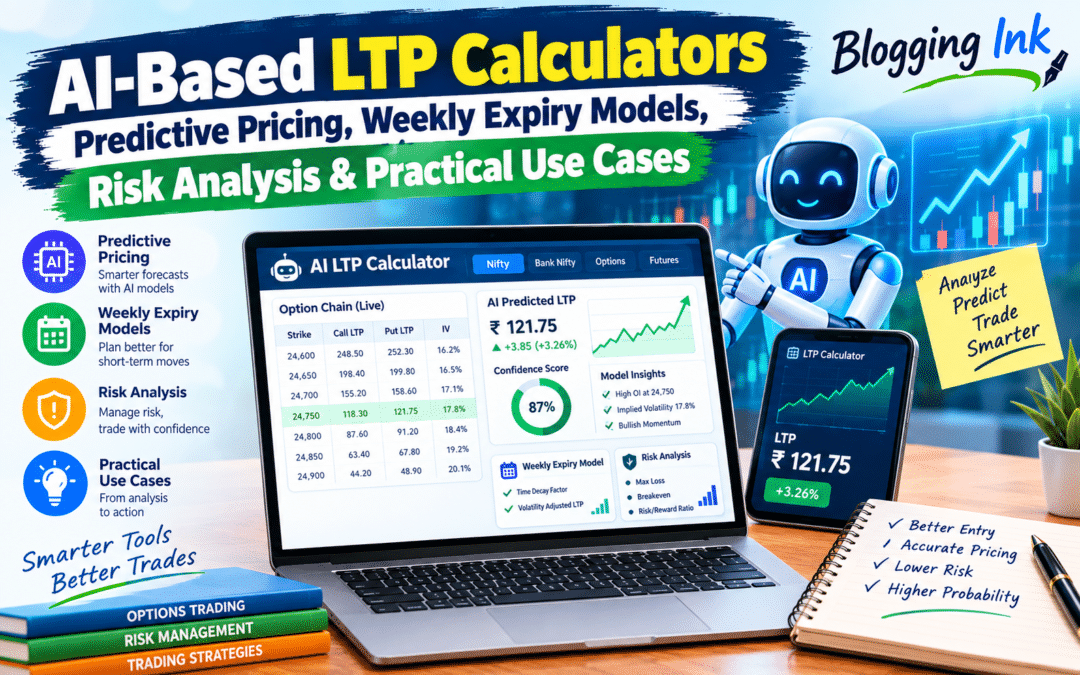
AI-Based LTP Calculators – Predictive Pricing, Weekly Expiry Models, Risk Analysis & Practical Use Cases
In Part 6 we looked at the NiftyTrader option chain the NSE option chain live LTP calculator, tools for analyzing options and free calculators for Nifty, Bank Nifty and Sensex. In this part we will take a look at how Artificial Intelligence is changing the way traders analyze options. We will cover AI-powered LTP Calculators, predictive pricing models, weekly expiry analytics, risk assessment and real ways traders can use AI in an responsible way along with traditional option chain analysis.
The Rise of AI in Options Trading
Artificial Intelligence has made changes in many areas of financial markets. This includes trading, portfolio management, fraud detection and even customer support. In options trading AI is now being used to handle amounts of market data find patterns and help traders make better decisions.
An LTP Calculator powered by AI does not take the place of market experience. It also does not promise trades. Instead it works like an assistant. It looks at factors at the same time including:
- Last Traded Price (LTP)
- Open Interest (OI)
- Change in Open Interest
- Implied Volatility (IV)
- Trading Volume
- Option Greeks
- Historical price behavior
- Market trend
- Expiry dynamics
This helps traders process information more quickly than they can on their own.
What Is an AI-Based LTP Calculator?
An AI-based LTP Calculator mixes ideas about option pricing with machine learning or statistical models. Its goal is to help traders understand option contracts better.
Unlike a tool that only shows current market data AI tools can do more. They can:
- Pick out activity in options
- Compare how premiums behaved in the past with how they act now
- Point out shifts in volatility
- Estimate risks
- Suggest option contracts that meet certain goals
- Turn complex option chain data into clear insights
These tools are meant to support decisions—not to predict the future with perfect accuracy.
How AI Processes Option Chain Data
AI systems look at market inputs all together. Here are some common variables. What AI does with them:
| Market Variable | AI Analysis | |
| LTP | Studies how premium moves | |
| Open Interest | Tracks where positions are building up | |
| Change in OI | Shows if new money is entering or exiting | |
| Volume | Checks how liquid a contract is | |
| IV | Understands the volatility environment | |
| Greeks | Measures how sensitive premium is | |
| Underlying Price | Follows direction of the main asset | |
| Expiry | Analyzes effects of time decay |
By studying how these variables connect AI can spot patterns that might be hard to see when reviewing the option chain by hand.
AI and Predictive Pricing
One of the talked-about uses of AI is predicting prices.. Ai does not forecast exact future prices. Instead it estimates how option premiums might react under situations based on past trends and current data.
Examples of scenarios AI may study:
- A move of 100 points in Nifty
- A spike in implied volatility
- Faster time decay near expiry
- Rising Open Interest at one strike
- High trading volume
These projections give traders a sense of what could happen.. They are only estimates—nothing is guaranteed.
Understanding Predictive Models
Predictive pricing models usually include:
- Volatility
- Recent price movement
- Current implied volatility
- Time left until expiry
- Strike price compared to the underlying
- Liquidity conditions
For example:
Current Nifty: 25,000
ATM Call Premium: ₹150
The model might guess how this premium could change if:
- Nifty goes up to 25,100
- Implied volatility increases by 3%
- One full trading day passes without big price changes
Such analysis helps traders think through various possibilities before acting.
AI and Weekly Expiry Analysis with AI-Based LTP Calculators
Weekly expiry options come with challenges. Option premiums often shift fast because of time decay and quick intraday swings.
Some AI tools designed for expiries focus on:
- Quick drops due to Theta decay
- Intraday volatility spikes
- Rapid changes in premium
- How sensitive strikes are to price moves
- Risk levels right before expiry
These insights can help traders stay alert.. It’s important to remember that markets on expiry days can be very unpredictable.
Example
Current Nifty: 25,000
One day before expiry:
| Strike | LTP | |
| 25,000 CE | ₹52 | |
| 25,100 CE | ₹18 | |
| 25,200 CE | ₹5 |
An AI model might suggest how these premiums could behave if prices move in a certain way. However unexpected news sudden changes in liquidity or sharp volatility jumps can cause actual prices to differ from predictions.
AI and Risk Analysis with AI-Based LTP Calculators
Risk management is one of the benefits of using AI in options trading. Than just focusing on profits AI helps traders understand exposure by looking at:
- Position size
- Volatility levels
- Option Greeks
- Maximum theoretical loss based on strategy
- How a trade connects to other open positions
- Risks tied to expiry
This broader view pushes traders to think about losses before making a trade.
Volatility Forecasting
Implied Volatility plays a role in setting option prices. AI models can examine:
- How low IV has been historically
- Where current IV stands as a percentage
- Upcoming events that could affect markets
- Changes in who is trading options
- Links between different markets
While this adds useful context volatility stays uncertain. Unexpected events can push IV up or down quickly.
AI and Option Greeks
Modern AI-powered calculators don’t just show values—they tie them together in meaningful ways. Here’s how each works:
Delta: Shows how the option premium changes with moves in the underlying.
Gamma: Tells how fast Delta itself changes.
Theta: Estimates how value an option loses each day.
Vega: Measures how sensitive the price’s to changes in implied volatility.
Rho: Evaluates sensitivity to interest rate changes.
Of listing these separately AI tools combine them to give a clearer picture of how an option might react.
Practical Use Case 1: Strike Price Selection
Suppose:
Current Nifty = 25,000
Available calls:
| Strike | LTP | |
| 24,900 CE | ₹210 | |
| 25,000 CE | ₹155 | |
| 25,100 CE | ₹108 |
An AI tool could compare:
- How far the strike is from the underlying
- Liquidity levels
- Open Interest
- Implied Volatility
- Delta values
It may then suggest which options best match the traders goals. The final call still rests with the trader.
Practical Use Case 2: Comparing Multiple Expiries
Let’s say two expiries are available:
Weekly : 25,000 CE / Premium: ₹150
Monthly : 25,000 CE / Premium: ₹245
An AI model can compare:
- The amount of time value
- How fast premium decays
- Vega impact
- How sensitive the premium is to price moves
This helps traders see why monthly options cost more than ones.
Practical Use Case 3: Monitoring Open Interest
AI systems can notice shifts in Open Interest faster than a person can.
Example:
| Strike | OI Change | |
| 24,900 | +40,000 | |
| 25,000 | +1,60,000 | |
| 25,100 | +15,000 |
Rather, than just showing numbers AI might highlight the big jump at 25,000. Traders should then check price action and other signs to see if this reflects buildup, short buildup or something else.
Practical Use Case 4: Volatility Monitoring
Imagine this:
Current IV: 14%
Historical average: 18%
An AI model might point out that implied volatility is currently lower than its average. That’s information. It can prompt traders to look closer. It shouldn’t be treated as a signal to jump into a trade all by itself. Volatility is one piece of the puzzle.
AI for Strategy Evaluation
Some platforms now use AI to help with complex option strategies. These include:
- Bull Call Spread
- Bear Put Spread
- Iron Condor
- Iron Butterfly
- Long Straddle
- Short Strangle
AI can estimate key metrics:
- Maximum profit
- Maximum loss
- Breakeven points
- Risk exposure
- Probability scenarios. Though these depend on the model used
These features can make it easier for traders—especially those still learning—to evaluate strategies that might otherwise feel too complicated.
Benefits of AI-Based LTP Calculators
Using AI tools for traded price (LTP) analysis offers several advantages:
- Faster handling of big data sets
- Better identification of patterns
- Quick comparison across strike prices
- Cleaner organization of option chain data
- Support in analyzing volatility
- More focused risk insights
- Time saved for traders who are active every day
When used correctly AI helps traders digest information faster and make clearer decisions.
Limitations of AI-Based Calculators
With all their benefits AI tools are not perfect. They cannot:
- Predict the future with any certainty
- Remove market risk
- See every news event coming
- Replace risk management
- Confirm that a trade will make money
Markets are shaped by sudden events, emotions, shifts in liquidity and big economic changes. No model can fully account for all of that. That’s why AI should never be trusted completely.
Common Mistakes When Using AI
Traders often make errors when relying heavily on AI. These include:
- Going with AI advice without checking it themselves
- Skipping Open Interest, Volume or Implied Volatility
- Believing AI predictions are always
- Not adjusting for changing market conditions
- Taking large a position based on model results
- Forgetting about stop-loss and proper position sizing
AI works best when it fits into a larger well-thought-out trading plan. It’s a helper, not a decision maker.
Best Practices for Combining AI with Traditional Analysis
Top traders don’t rely on AI. They mix it with proven methods. A smart process might look like this:
- Look at the market trend
- Check charts
- Review the option chain
- Use the LTP Calculator to compare values
- Take note of AI-generated insights
- Double-check everything with Open Interest, IV and Greeks
- Set risk limits
- Only enter the trade if it matches the plan
This way decisions come from a balanced mix of tools not just one system.
Internal Linking Opportunities
This section ties naturally to educational articles, such as:
- Option Greeks Explained
- How AI Is Changing Trading
- Implied Volatility Guide
- Weekly Expiry Trading Strategies
- Open Interest Analysis
- Risk Management in Options Trading
- Bull Call Spread Strategy
- Iron Condor Explained
- Understanding Theta Decay
These links help strengthen the content and give readers insight into different parts of options trading.
Takeaways
- AI-based LTP Calculators help analyze options by looking at multiple factors at once—LTP, Open Interest, Implied Volatility, Volume and Greeks.
- Predictive models can show how premiums might change under conditions—but they don’t promise results.
- AI supports expiry analysis, risk checks, volatility tracking and strategy evaluation. It’s a tool, not a magic solution.
- The strongest trading approach combines AI insights, with option chain review, technical analysis and careful risk control.
- Successful options trading still depends on discipline, good judgment, smart position sizing and ongoing learning—not automated signals.
In Part 8, we’ll examine the most common mistakes options traders make when using an LTP Calculator and the NSE Option Chain. We’ll cover option buying errors, option selling mistakes, expiry-day pitfalls, volatility traps, and practical risk management techniques that can help traders avoid costly decisions and build a more disciplined trading process.
Recent Comments