
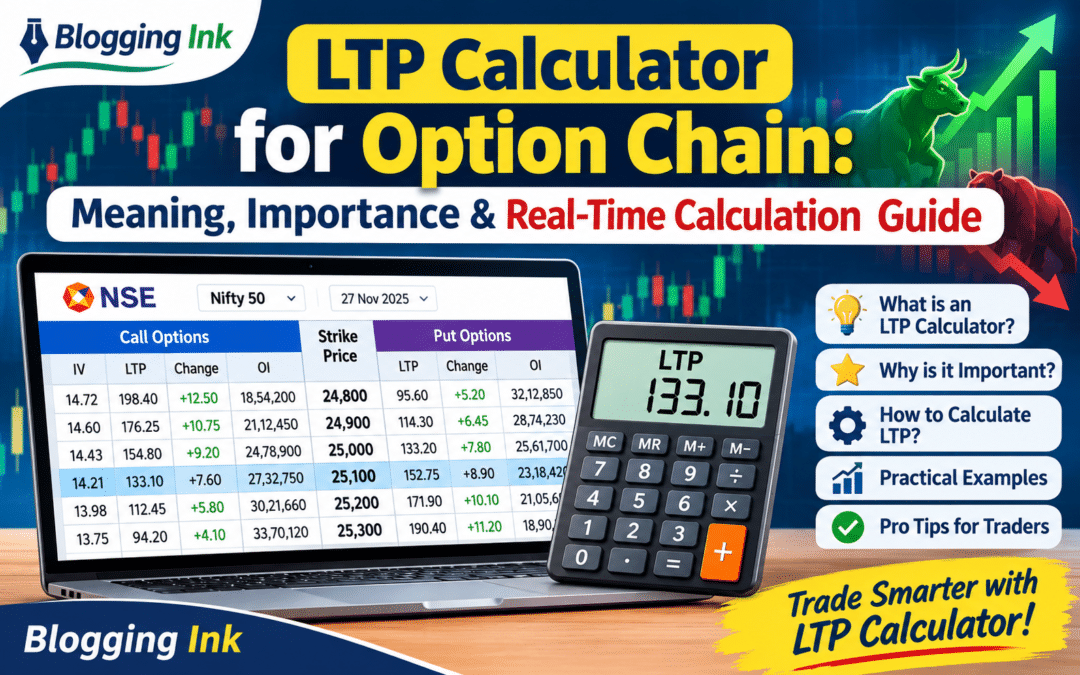
LTP Calculator for Option Chain: Meaning, Importance & Real-Time Calculation Guide
LTP Calculator for Option Chain:-
The Indian stock market has become very popular with traders who want to understand how prices change find trading chances and look at derivatives better. One of the tools that options traders use is an LTP calculator. It plays a role in understanding option premiums and looking at different strike prices.
An LTP Calculator For Option Chain is a tool that lets traders look at the Last Traded Price (LTP) of call and put options. By using information from the option chain and pricing calculations traders can better understand how option premiums work in market situations.
No matter if you are trading Nifty 50 Bank Nifty, Sensex or options for stocks knowing about LTP is important for making smart choices. Option premiums are affected by a number of things including the price of the asset the strike price, when it expires how volatility there is, interest rates and how much time is left until it expires.
At Blogging Ink our purpose is to explain ideas in a simple, useful and educational way. This guide looks at what an LTP calculator’s why it is important in option-chain analysis, how it is calculated, examples of how it works the benefits it offers the things it can’t do and advice on using it the right way.
What Is an LTP Calculator For Option Chain?
LTP stands for Traded Price. It is the price at which the latest trade happened for an option contract.
An LTP calculator is a tool used to look at or guess option premiums using market data and math models. Depending on what it can do it might show the LTP guess theoretical option prices or calculate how premiums could change based on the market inputs you select.
An LTP Calculator For Option Chain can help compare the premiums of strikes and expiration dates. It can also help traders understand how the price of an option relates to the market it is based on.
For example if Nifty is trading near 25,000 and a 25,100 Call option has an LTP of ₹150 that means the last trade for that option contract happened at ₹150 per unit.
₹150 Is not the price you will get for your next trade. The current bid and ask prices how much the market is. The order book conditions decide what price is available for a new trade.
Meaning of LTP in the NSE Option Chain
The NSE option chain is a table that shows call and put contracts for an asset and expiration date.
It usually has information like:
- Strike Price
- Last Traded Price (LTP)
- Open Interest (OI)
- Change in Open Interest
- Trading Volume
- Implied Volatility (IV)
- Bid Price
- Ask Price
Calls and puts are on sides of the strike price column. Each strike has its premium that changes as the market moves.
An LTP Calculator For Option Chain helps traders understand these numbers and see how premiums change with the market.
Why Is an LTP Calculator Important in Options Trading?
Options trading is more than guessing if the market will go up or down. Traders also need to look at the option premium how volatility there is, when it expires, how liquid it is and the possible risk.
An LTP calculator can help with all these things.
1. Understanding Option Premiums
The premium is what the buyer pays to get an option contract. It is what the seller gets before considering fees and margin requirements.
An LTP calculator helps traders see how option premiums are related to strike prices and market changes.
For example an at-the-money option might have a premium than an out-of-the-money option even if they are both for the same expiration.
2. Comparing Different Strike Prices
Options traders often look at strike prices before picking a contract.
If Nifty is at 25,000 a trader might look at these Call options:
| Strike Price | Illustrative LTP | |
| 24,900 CE | ₹185 | |
| 25,000 CE | ₹140 | |
| 25,100 CE | ₹105 | |
| 25,200 CE | ₹75 |
These numbers are just examples and not real prices.
The comparison helps traders see the differences in premiums between strike prices.. The cheapest option is not always the best choice because it might not have a good chance of being in the money or might not be very liquid.
3. Looking at Changes in Premiums
Option premiums can change even if the asset doesn’t move much.
An LTP calculator using a pricing model can guess how the premium might change when the asset price, volatility or time to expiration changes.
This is especially helpful for understanding how sensitive options are to market changes.
4. Helping with Risk Management
Before making a trade traders should guess how much they might lose.
For a long option position:
Maximum Possible Loss = Premium Paid × Quantity
For example if the premium is ₹100 and you buy 50 units:
Maximum loss before fees = ₹100 × 50 = ₹5,000.
This assumes the option is bought and held until expiration and ends up with no value. A buyer can also sell before expiration possibly making a profit or loss.
An LTP calculator can help with risk analysis. It can’t guarantee the market will behave as expected.
5. Making Option Chain Analysis Better
Option chain analysis becomes more useful when LTP is looked at with Open Interest, Volume, Implied Volatility and the Bid-Ask Spread.
The premium alone doesn’t tell the story about the market.
How Does an LTP Calculator For Option Chain Work?
An LTP calculator can work in ways depending on the website or tool.
Some tools show the LTP that the exchange gives. Others use math models to guess the price of an option.
It’s important to know the difference between these two things.
Live LTP Data
Live LTP comes from trades and market data.
When a new trade happens in an option contract the reported LTP may change to show the trade.
The real LTP is not guessed by averaging prices or using a math formula. It is based on the trade that happened.
Option Price Calculation
A theoretical price for an option can be guessed using a model like Black-Scholes.
For a European Call option the Black-Scholes formula is:
C = S × N(d₁) − K × e⁻ʳᵀ × N(d₂)
For a European Put option:
P = K × e⁻ʳᵀ × N(−d₂) − S × N(−d₁)
Where:
- C = Theoretical Call price
- P = Theoretical Put price
- S = Current price of the asset
- K = Strike price
- r = Risk-free interest rate
- T = Time until expiry in years
- N = Cumulative standard normal distribution
- e = A number
- d₁ and d₂ = Numbers calculated from price, volatility, interest rate and time
The numbers are calculated as:
d₁ = [ln(S/K) + (r + σ²/2)T] / (σ√T)
d₂ = d₁ − σ√T
In this case σ means the volatility.
These formulas are used to guess the price of an option under conditions. They don’t guarantee the price in the market.
The Black-Scholes model is made for options. Other models might be better for some contracts or market situations.
Real-Time Calculation Guide: Step-by-Step
Using an LTP calculator is easier when traders follow a process.
Step 1: Choose the Asset
First choose the asset you want to look at.
Examples are:
- Nifty 50
- Bank Nifty
- Sensex
- Reliance Industries
- HDFC Bank
- Other F&O stocks
The asset you pick will decide which options you look at.
Step 2: Pick the Expiry Date
Choose the date when the option will expire.
Weekly and monthly expiries can act differently. Options with time to expiry usually have less time value but their prices can still change a lot.
Make sure the expiry date you choose matches the one in the option chain.
Step 3: Pick the Strike Price
Choose the strike price you want to check.
Strike prices are usually divided into:
- In the Money (ITM)
- At the Money (ATM)
- Out of the Money (OTM)
For Call options strikes below the asset price are usually ITM. For Put options strikes above the asset price are usually ITM.
The ATM strike is the one to the current asset price.
Step 4: Enter the Asset Price
If the calculator needs it type in the price of the asset.
For example:
Asset Price = 25,000
Use up-to-date data. A late asset price can lead to guesses.
Step 5: Enter Volatility
Implied volatility is important for guessing the price of an option.
Higher implied volatility usually makes the guessed price higher for both Call and Put options if everything else stays the same.
If your calculator needs volatility use a value from the contract or a market data source.
Step 6: Enter Time to Expiry and Interest Rate
The time left until it expires affects the time value of the option.
The interest rate is another input used in pricing models. Make sure the time and interest rate numbers match what the calculator expects.
Step 7: Calculate and Compare the Results
After you enter the numbers calculate the guessed price.
Compare the result with the LTP, from the exchange the bid price and the ask price.
A difference between price and LTP does not automatically mean that an option is mispriced. Differences can happen because of volatility assumptions, market liquidity, data timing or model limitations.
Practical Example of an LTP Calculator For Option Chain
Lets understand the idea through a Nifty example.
Assume the following market inputs:
| Parameter | Illustrative Value | |
| Nifty Spot Price | 25,000 | |
| Strike Price | 25,100 | |
| Option Type | Call | |
| Expiry | 7 days | |
| Implied Volatility | 15% | |
| Risk-Free Rate | 6% | |
| Market LTP | ₹105 |
These numbers are just for explanation and do not show real NSE market data.
Suppose a theoretical pricing model predicts the option premium at ₹108.
The difference between price and market LTP is:
Price Difference = Theoretical Price − Market LTP
Price Difference = ₹108 − ₹105 = ₹3
The theoretical premium is ₹3 more than the LTP.
This difference can be used for analysis. A trader should look at the bid-ask spread, liquidity, volatility assumptions and timing before making any conclusion.
The LTP Calculator For Option Chain can help traders compare these values. A theoretical premium should not be seen as a guaranteed future market price.
Understanding the Option Premium
An option premium has two parts:
Option Premium = Intrinsic Value + Time Value
For a Call option:
Intrinsic Value = Maximum of (Underlying Price − Strike Price 0)
For a Put option:
Intrinsic Value = Maximum of (Strike Price − Underlying Price, 0)
If Nifty is at 25,000 and the Call strike is 25,100 the Call is out of the money.
Its intrinsic value is:
Maximum of (25,000 − 25,100 0) = ₹0.
Therefore its premium comes from time value in this explanation.
The premium can still change because of changes in the underlying price implied volatility and time remaining until expiry.
LTP vs. Bid Price vs. Ask Price
It is important to know the difference between LTP, Bid and Ask.
| Price Type | Meaning | |
| LTP | Price of the most recent completed transaction | |
| Bid Price | Highest current price a buyer is willing to pay | |
| Ask Price | Lowest current price a seller is willing to accept |
For example an option may have:
- LTP: ₹100
- Bid: ₹99
- Ask: ₹102
The spread is ₹3
A buyer placing a market order may get near the ask while a seller may get near the available bid. The actual execution depends on what’s in the order book.
The LTP can also become outdated when an option is not traded often. This is why traders should not rely on LTP
Major Factors Affecting Option LTP
The premium of an option is affected by important things.
1. Underlying Asset Price
An increase in the underlying asset usually raises Call premiums. Lowers Put premiums assuming everything else stays the same.
The impact depends on the options Delta and other market conditions.
2. Strike Price
The relationship between the strike and underlying price affects value and the options moneyness.
3. Time to Expiry
Options usually have time value. As expiry gets closer time value tends to go down a process known as time decay.
4. Implied Volatility
Implied volatility shows the level of volatility that is expected from the option prices.
An increase in implied volatility usually raises both Call and Put premiums assuming other inputs stay the same.
5. Interest Rates
Interest rates affect option prices, especially through the present value of the strike price and the cost of holding the underlying.
6. Market Liquidity
Liquidity affects the bid-ask spread and how easy it is to trade.
An option with a spread can cost more to trade than one with a narrow spread.
Importance of Option Greeks in LTP Calculation
Option Greeks show how option prices react to factors.
Delta
Delta shows how the option premium changes when the underlying price changes, assuming everything else stays the same.
Call Delta is usually positive while Put Delta is usually negative.
Gamma
Gamma measures how Delta changes when the underlying price moves.
Gamma is often higher near expiry for options to the money.
Theta
Theta shows how the passage of time affects the option premium assuming everything else stays the same.
Long-option positions usually have Theta.
Vega
Vega shows how the option premium changes with a change in implied volatility.
Understanding these Greeks can make the LTP Calculator For Option Chain more useful for analyzing how theoretical premiums change.
How to Use LTP Alongside Open Interest and Volume
LTP should be looked at with option-chain data.
Open Interest
Open Interest shows how many outstanding option contracts are still active.
It can give a sense of where the most positionsre at different strike prices.
Change in Open Interest
Change, in OI shows how the number of positions has changed over a period.
It should be interpreted carefully because OI alone does not reveal whether positions are bullish or bearish.
Volume
Volume represents the quantity of contracts traded during a period.
High volume may indicate active trading, but it does not automatically indicate a profitable opportunity.
Implied Volatility
IV can help traders evaluate the volatility component of premiums.
An option premium may rise even when the underlying price remains relatively stable if implied volatility increases.
Combining these metrics provides a more complete view than using LTP alone.
Benefits of Using an LTP Calculator For Option Chain
An LTP calculator offers several educational and analytical benefits.
- Premium Analysis: Helps users understand option premiums and pricing variables.
- Strike Comparison: Makes it easier to compare premiums across strikes.
- Theoretical Pricing: Estimates option values using mathematical models.
- Risk Evaluation: Supports basic position-risk calculations.
- Market Understanding: Helps users explore the effects of volatility and time.
- Trading Preparation: Encourages structured analysis before entering a trade.
- Learning Support: Provides a practical way to understand options concepts.
For beginners, an LTP Calculator For Option Chain can be a useful learning tool. Experienced traders may use it as one component of a broader analysis process.
Common Mistakes to Avoid
Relying Only on LTP
The latest traded price is not necessarily the current executable price. Always check the bid and ask.
Ignoring Implied Volatility
An option’s premium may change significantly because of volatility, even when the underlying price moves very little.
Choosing Options Only Because They Are Cheap
Low-premium options may have lower probability of finishing in the money and may lose their value quickly.
Ignoring Expiry
Time to expiry is an important input in option pricing. A short-dated option may behave differently from a longer-dated option.
Treating Theoretical Price as a Prediction
A pricing model estimates value under assumptions. It does not predict the future market price with certainty.
Ignoring Transaction Costs
Brokerage, taxes, exchange charges, and slippage can affect actual trading results.
Trading Without a Risk Plan
Every options trade should have a defined risk approach. Traders should understand their position size, potential loss, and exit conditions.
Pro Tips for Better Option Chain Analysis
- Check the underlying price before analyzing strikes.
- Select the correct expiry date.
- Compare ATM, ITM, and OTM premiums.
- Examine bid-ask spreads before placing orders.
- Review implied volatility and option Greeks.
- Observe Open Interest and Volume together.
- Avoid relying on stale LTP data.
- Use a theoretical calculator as an analytical reference.
- Maintain a trading journal to review decisions.
- Never assume a calculator can guarantee profits.
Blogging Ink recommends using analytical tools as part of a disciplined learning and risk-management process rather than treating them as standalone trading signals.
Frequently Asked Questions (FAQs)
- What is an LTP Calculator For Option Chain?
An LTP calculator is a tool used to analyze option premiums. Depending on its features, it may display live LTP data or estimate theoretical option prices using pricing models and market inputs.
- What is the full form of LTP?
LTP stands for Last Traded Price. It is the price at which the most recent completed transaction occurred in a particular option contract.
- Is LTP the same as the current market price?
Not necessarily. LTP is the price of the latest completed trade. The current bid and ask prices show the best available buying and selling quotes.
- Can an LTP calculator predict future option prices?
No. A calculator may estimate theoretical prices based on selected inputs, but actual option premiums depend on changing market conditions.
- How is an option premium calculated?
Theoretical option premiums can be estimated using models such as Black-Scholes. These models consider variables such as underlying price, strike price, time to expiry, volatility, and interest rates.
- Does LTP change in real time?
LTP can update when new trades occur. The update frequency depends on the market data feed and the platform displaying the information.
- Why is LTP different from the bid or ask price?
LTP reflects the most recent completed trade. Bid and ask prices reflect current orders from buyers and sellers.
- Is an LTP calculator useful for beginners?
Yes. It can help beginners understand option premiums, strike-price comparisons, and pricing variables. Beginners should also learn about risk, volatility, and expiry.
- Can I use an LTP calculator for Nifty and Bank Nifty?
A suitable calculator can be used to analyze Nifty, Bank Nifty, and other supported derivatives. The selected underlying, expiry, and contract specifications must match.
- Does a low LTP mean an option is a good trade?
No. A low premium does not necessarily mean an option is undervalued. Traders should examine moneyness, volatility, liquidity, expiry, and potential risk.
Conclusion
Understanding option premiums is an important part of derivatives trading. LTP provides a reference for the most recent transaction, while theoretical pricing models help explain how option values may respond to changes in market variables.
An LTP Calculator For Option Chain can help traders compare strike prices, analyze premiums, understand pricing factors, and develop a more structured approach to option-chain analysis.
However, no calculator can guarantee accurate future prices or profitable trades. Market conditions can change quickly, particularly during volatile sessions and near expiry.
By combining LTP with Open Interest, Volume, Implied Volatility, option Greeks, bid-ask spreads, and disciplined risk management, traders can develop a more comprehensive understanding of options.
At Blogging Ink, we believe that financial knowledge and practical analysis are essential for responsible trading. Use an LTP calculator as a learning and analytical resource, verify market data carefully, and make decisions based on a well-defined trading plan.
Explore more stock market guides, option-chain tutorials, and financial tools on Blogging Ink to strengthen your understanding of derivatives trading.
Disclaimer: This article is for educational and informational purposes only. It is not investment advice or a recommendation to buy or sell any financial instrument. Options trading involves substantial risk and may result in significant losses. Always verify market data and consult a qualified financial professional when appropriate.
Recent Comments