
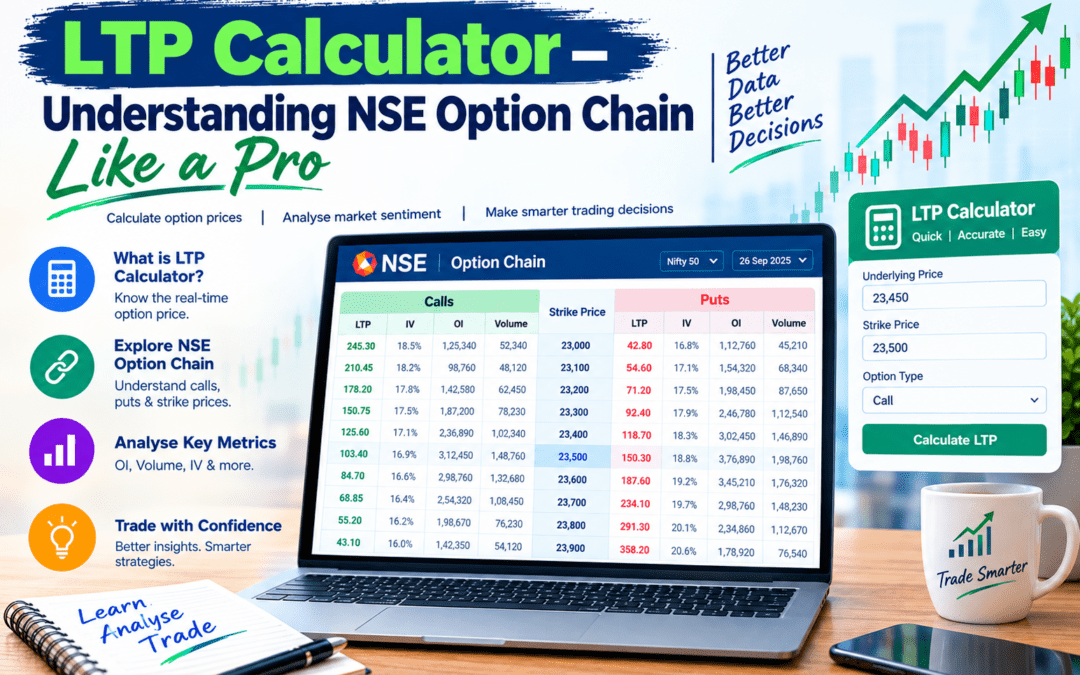
An LTP Calculator is a tool for traders who want to better understand option pricing. It helps estimate and analyze the Traded Price (LTP) of options by using live data from the NSE Option Chain. This allows traders to compare options find good strike prices assess risk and make smarter trading choices.
Whether you trade Nifty, Bank Nifty, Sensex or commodity derivatives combining an LTP Calculator with option chain analysis gives you a picture of market conditions. You can spot trends, gauge sentiment. Improve your chances of making successful trades.
Options trading has changed a lot in years. Traders now rely on data and tools of just charts or gut feelings. The LTP Calculator is one of those tools. It helps traders see how option premiums behave under situations. By looking at the picture. Including open interest implied volatility and Greeks. Traders can judge if an option is priced fairly.
Beginners often pick options based on low premium values.. Experienced traders take more time. They look at the option chain and use tools like the LTP Calculator to check whether a trade makes sense. This guide will help both new and seasoned traders understand the basics of the LTP Calculator and how it works with the NSE Option Chain.
By the end you’ll know:
- What an LTP Calculator is and why it matters
- How the NSE Option Chain functions
- Why option premiums change over time
- How to read and use option chain data
- How top traders combine these tools for better results
What Is an LTP Calculator?
An LTP Calculator is a tool that helps traders analyze and predict the Last Traded Price of an option. It uses time or delayed market data to give insights into how option prices move. Of just showing the last price advanced calculators help interpret that price in context.
The main goal is to help traders understand how option premiums react in markets. Key features include:
- Comparing strike prices
- Looking at different expiry dates
- Watching premium changes over time
- Finding possible entry and exit levels
- Making better decisions based on data
A modern LTP Calculator linked to the NSE Option Chain lets users check many contracts at once. Some versions add volatility, open interest and option Greeks to give a fuller view.
Core Functions of an LTP Calculator
| Feature | Benefit |
| Live option premium tracking | See current prices as they change |
| Strike price comparison | Check different strikes in one place |
| Expiry analysis | Compare weekly vs monthly expiries |
| Premium movement | Track price changes over time |
| Risk estimation | Undrstand potential losses |
| Market sentiment insights | Combine price with chain metrics |
These functions are helpful for all levels of traders. From beginners learning the basics to pros managing complex strategies.
Understanding LTP in Options Trading
LTP stands for Last Traded Price. This is the recent price at which an option contract was bought or sold on the exchange. Every trade updates this value. So the number changes constantly.
For example:
- -25,000 CE
- Last trade happened at ₹152
- Current LTP = ₹152
If the next trade comes in at ₹155 the LTP updates to ₹155.
But here’s the thing: LTP is not the price you’ll get when you try to buy or sell. You should also look at the bid. Ask prices how much liquidity there is and what execution costs might be. That’s because the actual price you pay depends on supply and demand.
Why Does the LTP Change?
Several things affect how option prices move:
- Movement in the index or stock
- Time left until expiration
- Changes in implied volatility
- Supply and demand
- Interest rates (minor effect)
- Market mood
- News or big events
For instance if Nifty goes up fast call options usually become more expensive while put options drop in price. The amount of change depends on the strike, time to expiry and volatility.
Components of an Option Premium
Every option premium has two parts:
| Component | Description |
| Intrinsic Value | The profit you’d get if you exercised today |
| Time Value | Extra value based on future chance of profit |
Intrinsic Value, This is the difference between the current price of the underlying asset and the strike price but only if the option is in-the-money.
Example:
- Nifty = 25,000
- 24,800 Call Option
Intrinsic Value = 25,000 − 24,800 = ₹200
Time Value, This represents how much extra the option is worth due to the chance it could become profitable before expiry. As expiration gets closer time value drops. This is called time decay or Theta decay.
Example:
- Total Premium = ₹260
- Intrinsic Value = ₹200
Time Value = ₹260 − ₹200 = ₹60
Knowing how intrinsic and time value interact helps traders understand what they’re paying for in an option.
What Is the NSE Option Chain?
The NSE Option Chain is a table listing all options for a specific underlying. Like Nifty, Bank Nifty, Sensex or a stock. It shows both call (CE) and put (PE) options across strike prices and expiry dates.
It’s one of the important tools for options traders because it brings together key information in one place.
A typical option chain includes:
- Strike Price
- Call Option Data
- Put Option Data
- Traded Price (LTP)
- Open Interest (OI)
- Change in Open Interest
- Volume
- Bid Price
- Ask Price
- Implied Volatility (IV)
Traders use these numbers to find support and resistance levels check market sentiment and measure liquidity.
Simplified Option Chain Example
| Call LTP | Strike | Put LTP |
| ₹325 | 24900 | ₹58 |
| ₹250 | 25000 | ₹95 |
| ₹185 | 25100 | ₹145 |
| ₹130 | 25200 | ₹210 |
As the strike price goes up call premiums tend to go down and put premiums go up. Assuming everything else stays the same.
How the LTP Calculator and the Option Chain Work Together
The option chain gives you data. The LTP Calculator turns that data into insight. Think of the option chain as a dashboard and the calculator as an assistant.
Together they help traders go beyond just seeing prices. They help understand what those prices mean.
For example suppose two call options have premiums. The calculator can help decide which one offers value by looking at:
- How much time is left until expiry
- Implied volatility
- Distance from current market price
- Open interest
- Liquidity
This deeper look leads to smarter trades.
Example
Let’s say Nifty is at 25,050.
| Strike | LTP |
| 25000 | ₹190 |
| 25100 | ₹150 |
| 25200 | ₹115 |
of picking the lowest premium a trader can use the LTP Calculator to compare each option’s risk-reward balance, its time value and where it fits in the market.
Why Every Options Trader Needs an LTP Calculator
Most retail traders focus on whether the market will go up or down. Professional traders care about how option prices respond to those moves.
An LTP Calculator closes the gap. It helps traders:
- Judge option premiums without bias
- Compare contracts, across strikes and months
- Find times to enter and exit
- See how volatility affects pricing
- Plan trades more carefully
- When used right it becomes a powerful part of any trading strategy.
- Manage risk effectively.
Benefits for Beginners
For traders an LTP Calculator can:
- Make complex pricing ideas easier to understand.
- Help you learn how option premiums work.
- Cut down on guessing when making trades.
- Give you confidence by using clear step-by-step analysis.
Benefits for Experienced Traders
Advanced users can use an LTP Calculator to:
- Compare trading strategies in a short time.
- See how implied volatility changes over time.
- Keep track of how option premiums go down as time passes.
- Make decisions when placing trades.
- Use option chain data with Greeks and risk numbers for deeper analysis.
________________________________________
Key Takeaways
- The LTP Calculator is a tool for checking option premiums and helping you make smarter trading choices.
- The Traded Price is the most recent price at which a trade happened but you should always check it with other market info.
- The NSE Option Chain shows details, about available option contracts. Like their premiums, open interest, trading volume and implied volatility.
- Using an LTP Calculator with option chain analysis helps traders find trades handle risk better and get a clearer picture of what the market feels like.
- Learning these basics sets you up for advanced topics. Like option Greeks, AI-powered calculators and pro trading routines. Which will be covered in the next parts of this guide.
Up next in Part 2: We’ll explore every column of the NSE Option Chain in detail, including Open Interest (OI), Change in OI, Volume, Implied Volatility (IV), Bid/Ask prices, and practical examples of interpreting LTP data for real trading scenarios.
Recent Comments