
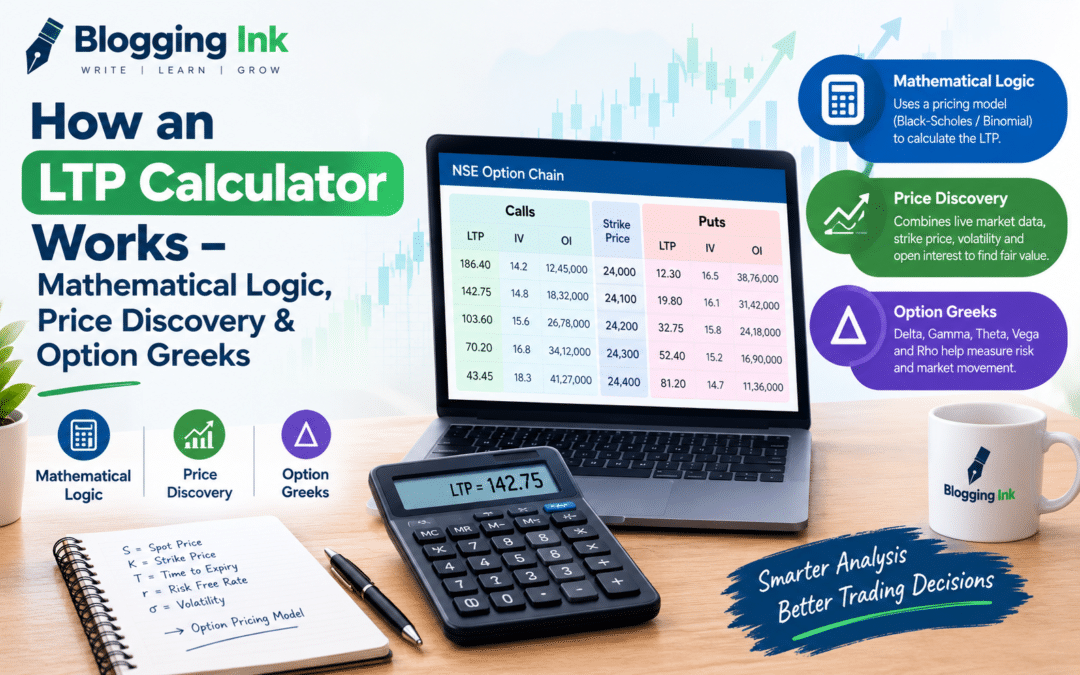
How an LTP Calculator Works?
In Part 2 we looked at every column in the NSE Option Chain. Learned how to read Open Interest (OI) Volume, Implied Volatility (IV) Bid/Ask prices and the Last Traded Price (LTP). In this part we will go further than reading the option chain. We will explore how the LTP Calculator works, how it uses market data how it calculates option prices and how it helps traders spot chances with basic math and option Greeks.
In this chapter, we’ll explore how an LTP Calculator works and how it helps analyze option prices.
Why Understanding the Logic Behind an LTP Calculator Matters
Many traders use the LTP Calculator without knowing how it reaches its estimates. Although the shown premium looks simple it depends on changing factors such as the price of the underlying asset the strike price, the time until expiry the implied volatility the interest rates and the market demand.
A modern LTP Calculator option chain does more than just show the premium. It mixes market data with pricing models to help traders:
- Compare many option contracts.
- Estimate an option value.
- Look at how premiums change.
- Check how volatility and time decay affect the price.
- Pick trades.
Knowing these mechanics lets traders read option prices of just reacting to them.
How an LTP Calculator Works / What Does an LTP Calculator Actually Do?
The LTP Calculator gets the option data and shows it in a way that helps with analysis and decision making.
A typical workflow involves:
- Get live. Delayed market data.
- Show the Last Traded Price (LTP).
- Compare premiums across strike prices and expiries.
- Calculate time value.
- Estimate how changes in the underlying asset affect the price.
- Show liquidity and volatility metrics.
Advanced calculators may also incorporate:
- Option Greeks such as Delta, Gamma, Theta, Vega and Rho.
- Open Interest (OI).
- Implied Volatility (IV).
- Probability estimates.
- Strategy payoff analysis.
This mix helps traders go beyond just tracking price.
Mathematical Logic Behind Option Pricing
Option pricing depends on how several variables relate to each other. Even though experts use models like Black–Scholes or Binomial Models the basic ideas are simple.
The primary factors affecting an options premium are:
| Factor | Effect on Premium | |
| Underlying price | Impact | |
| Strike price | Determines value | |
| Time to expiry | Time usually raises the premium. | |
| Implied volatility | Higher IV usually increases premium | |
| Interest rates | Less effect for most index options | |
| Dividends (stocks) | Can influence stock option pricing |
The LTP Calculator NSE Option Chain uses these variables to explain why premiums go up or down.
Price Discovery in Options Trading
Price discovery is how buyers and sellers set an options market value.
Unlike products with fixed prices option premiums keep changing because market participants keep adjusting their expectations.
Factors influencing price discovery include:
- Demand and supply.
- Expectations of market movement.
- Volatility.
- Liquidity.
- Economic announcements.
- Global market sentiment.
Example
Current Nifty: 25,000
25,000 CE:
- Buyer wants to pay ₹145.
- Seller wants ₹148.
Eventually both agree at ₹147.
The Last Traded Price (LTP) becomes ₹147 until another transaction occurs. This changing process shows why option premiums move during the trading session.
Live Data Integration
An effective NSE option chain live LTP Calculator depends on accurate market data.
Typical data points include:
- Underlying index or stock price
- Option premium (LTP)
- Bid and Ask prices
- Open Interest (OI)
- Change in OI
- Volume
- Implied Volatility (IV)
- Expiry dates
- Strike prices
As market conditions change these values update continuously enabling traders to monitor evolving opportunities.
Understanding Intrinsic Value
Intrinsic value is the portion of an option premium that reflects its exercise value.
Call Option Formula for How an LTP Calculator Works
Intrinsic Value = Current Market Price − Strike Price
If the result is intrinsic value is zero.
Example
Nifty = 25,300
Strike = 25,100 CE
Intrinsic Value:- 25,300 − 25,100 = ₹200
If the option premium’s ₹245:
- Intrinsic Value = ₹200
- Time Value = ₹45
Intrinsic value represents the options “real” value if exercised immediately.
Put Option Formula for How an LTP Calculator Works
Intrinsic Value = Strike Price − Current Market Price
Example
Nifty = 24,800
Strike = 25,000 PE
Intrinsic Value:- 25,000 − 24,800 = ₹200
If the premium is ₹235:
- Intrinsic Value = ₹200
- Time Value = ₹35
Understanding Time Value
Time value is the additional amount traders are willing to pay because there is still time before the option expires.
Time Value = Option Premium − Intrinsic Value
Example
Premium = ₹260
Intrinsic Value = ₹200
Time Value = ₹60
Time value reflects the possibility that the option could become more valuable before expiry.
Why Time Value Declines
As expiry approaches the opportunity for price movement decreases. Consequently time value erodes—a phenomenon known as Theta decay.
For example:
| Days to Expiry | Time Value | |
| 30 | ₹80 | |
| 15 | ₹55 | |
| 7 | ₹32 | |
| 1 | ₹8 | |
| Expiry ₹0 (if no intrinsic value remains) | ||
An advanced LTP Calculator helps traders visualize this decay and its impact on option premiums.
The Role of Implied Volatility
Implied Volatility (IV) measures the markets expectation of price movement.
Higher IV generally leads to option premiums because traders anticipate larger price swings.
Example
25,000 CE:
- IV = 14% → Premium = ₹120
- IV = 22% → Premium = ₹165
Even if Nifty remains unchanged an increase in IV can push the premium higher.
Conversely when IV falls after an event (such as an earnings announcement) option premiums may decline despite little movement, in the underlying asset. This phenomenon is often referred to as IV crush.
How the Underlying Asset Affects Premiums
Option prices are closely linked to the movement of the underlying asset.
Bullish Scenario
Nifty:- 25,000 → 25,150
outcome:
| Option | Old LTP | New LTP |
| 25,000 CE | ₹145 | ₹195 |
| 25,100 CE | ₹100 | ₹145 |
| 25,000 PE | ₹135 | ₹92 |
| Call premiums generally increase, while put premiums tend to decrease | ||
Bearish Scenario
Nifty:- 25,000 → 24,850
outcome:
| Option | Old LTP | New LTP |
| 25,000 CE | ₹145 | ₹96 |
| 25,000 PE | ₹135 | ₹182 |
| Put premiums generally increase, while Call premiums tend to decrease | ||
These examples show why option premiums do not move alone; they react to changes in the underlying asset, volatility and time.
Introduction to Option Greeks
Option Greeks show how an option premium is expected to shift when market variables change.
While an LTP Calculator shows the premium Greeks explain why the premium changes.
Delta: Delta measures how much an option premium is expected to change when the underlying asset moves one point.
Example
Delta = 0.60
Nifty rises by 100 points.
Expected premium increase:
100 × 0.60 = about 60 points (before variables).
Typical Delta ranges:
| Option Type | Approximate Delta | |
| ITM Call | 0.70 to 1.00 | |
| ATM Call | ~0.50 | |
| OTM Call | 0.10 to 0.40 | |
| ITM Put | -0.70 to -1.00 | |
| ATM Put | ~-0.50 | |
| OTM Put | -0.10 to -0.40 |
Gamma
Gamma measures how fast Delta changes when the underlying price moves. High Gamma means Delta can shift fast for at-the-money options near expiry. This explains why at-the-money option premiums can jump sharply during sessions.
Theta
Theta measures how time decay affects an option premium. A Theta of -5 means the option may lose about ₹5 of value each day just because time passes, if other variables stay the same.
Theta usually speeds up as expiry comes closer.
Vega:- Vega shows how an option responds to changes in implied volatility.
Example
Vega = 8
IV increases by 2%.
Estimated premium increase:
2 × 8 = about ₹16
Options with time to expiry usually have higher Vega because they are more sensitive to volatility changes.
Rho
Rho shows how changes in interest rates affect option premiums. For short-term index options Rho has a small influence compared to Delta, Theta or Vega.. Rho matters more for longer-dated contracts.
How LTP Calculators Use Greeks
Many modern platforms mix the LTP Calculator with option Greeks to give deeper insights.
Common features include:
- Live Delta values.
- Theta decay estimation.
- Vega exposure.
- Gamma sensitivity.
- Risk analysis.
- Multi-strike comparison.
- Probability metrics.
These features help traders see not the current premium but also how the premium may react to changing market conditions.
Practical Example: Comparing Two Call Options
Current Nifty = 25,000
| Metric | 25,000 CE | 25,200 CE |
| LTP | ₹155 | ₹82 |
| Delta | 0.52 | 0.28 |
| IV | 16% | 17% |
| Time Value | Higher | Higher (as a share of premium) |
| OI | High | Moderate |
Even though the 25,200 CE looks cheaper its Delta is lower. This means it may react slowly when Nifty goes up. An LTP Calculator option chain lets me and other traders compare these traits of picking contracts only because the premium is lower.
Common Misconceptions About LTP Calculators
- It does not predict prices. It only looks at what’s happening right now.
- It is not a guaranteed profit tool. Successful trading still needs a strategy and good risk management.
- A low premium does not always mean value. Time decay, a Delta or poor liquidity can explain why the price is lower.
- A high premium is not always expensive. It may contain a lot of value or show higher expected volatility.
Understanding these limitations helps traders use the LTP Calculator appropriately.
Best Practices for Using an LTP Calculator
- Compare strike prices before you enter a trade.
- Look at Open Interest and the change in Open Interest with the premiums.
- Watch Implied Volatility, especially when big events are coming.
- Notice the bid‑ask spreads and the trading volume.
- Think about how time decay will affect the price as expiry gets nearer.
- Use the Greeks to see how the premium might change of relying only on the LTP.
Key Takeaways
- An LTP Calculator looks at option premiums by mixing market data with ideas like intrinsic value, time value and implied volatility.
- Option prices are affected by things, such as the price of the underlying asset the strike price, how long, until expiry and what the market expects.
- Price discovery happens when buyers and sellers keep trading. The Last Traded Price is always changing.
- The option Greeks — Delta, Gamma, Theta, Vega and Rho—show how and why premiums shift in market situations.
- Using an LTP Calculator with the NSE Option Chain, Open Interest Implied Volatility and the Greeks gives a fuller picture when you judge option trades.
In Part 4, we’ll take a hands-on approach with a step-by-step guide to using an LTP Calculator. We’ll walk through practical examples for Nifty, Bank Nifty, Sensex, commodities, and weekly expiry trades, demonstrating how to analyze strike prices, compare premiums, and make informed trading decisions using real-world scenarios.
Do some research :- Black–Scholes Model | Binomial Models
Recent Comments